Our Work
Reforesting the Nebbi District since 2022
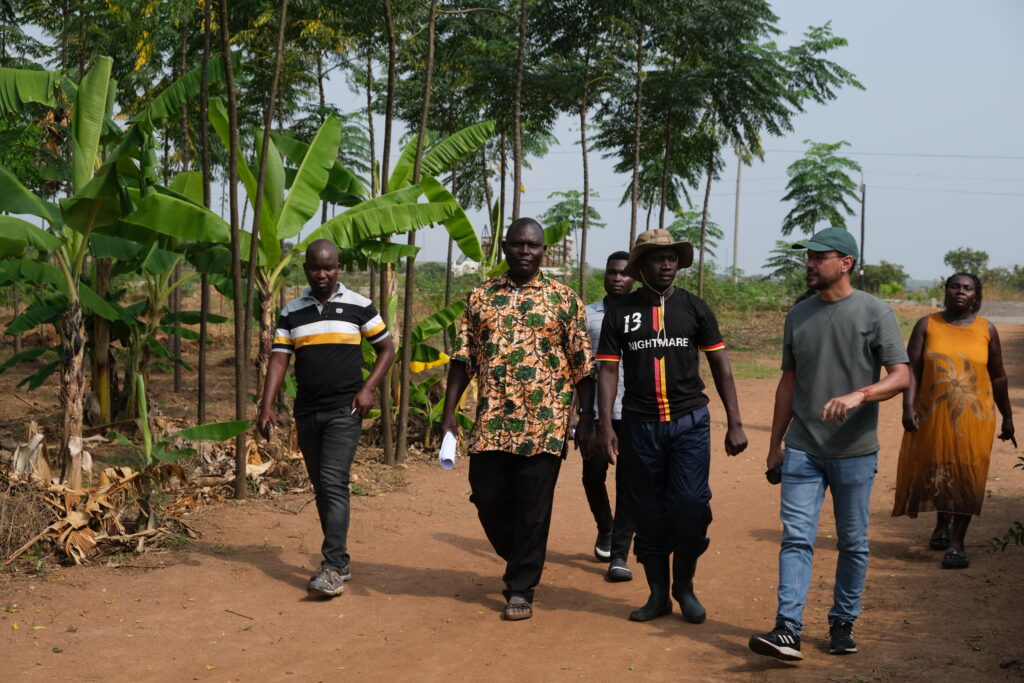
Since 2022, The Trees Project has been restoring forest cover in the Nebbi District of Uganda’s West Nile region. The initiative is led by Amici di Angal in partnership with local institutions, farmers, schools and parishes. Across 149 monitored sites, more than 32,000 trees of eleven species are now growing under a shared programme of planting, training and field monitoring.
The context
The West Nile region of Uganda sits at the intersection of ecological richness and environmental stress. Once covered by extensive forests ranging from savannahs to rainforests, the area has lost close to half its original forest cover over the past few decades, with profound effects on soil fertility, agricultural productivity, and the daily resilience of communities.
Between 1990 and 2015, Uganda’s forest cover dropped by 60%, with a 25% decline in just the five years from 2010 to 2015. The eastern region (where we work) today retains only 7.5% of the country’s forest area, making it one of the most deforested parts of the country.
Five pressures continue to erode what remains: rapid population growth and the demand for housing and cooking wood; a subsistence agriculture that prioritises short-cycle crops over forestry; commercial farming that claims land once left to scrub and forest; and a shifting climate, where long droughts alternate with torrential rains and floods that damage crops and young trees alike. Our work responds directly to each of these pressures.
How we work
Reforestation and agroforestry
Training
Monitoring
Planting trees across the Nebbi District and integrating them into farmland, with the aim of restoring soil, improving harvests, and diversifying household income. Eleven species are currently in the ground: timber, fruit, and nitrogen-fixing varieties.
Building capacity with local caregivers, farmers, schools, and parishes. Training covers nursery management, planting technique, pruning, pest control, and long-term stewardship. To date, 150 caregivers have been trained, with knowledge cascading into their communities.
Every planting site is georeferenced and tracked. Field reports record species composition, tree counts, and agronomic observations (weeding, firelines, fencing). Accountability is not a claim; it is a file that can be opened and read.
Our numbers
150+
32,000+
11
149
Caregivers trained
Trees planted
Species
Monitored sites
Where we work
The project is rooted in the Nebbi District of Uganda’s West Nile region. It’s a landscape of rolling hills, smallholder farms, and villages stretched across seven sub-counties: Nyaravur, Parombo, Nebbi, Koch Pangero, Kucwiny, Akworo, and Alala. Planting and monitoring sites are distributed across dozens of villages and institutions, from family compounds to schools, parishes, and health centres.
Our approach
The project rests on a motivated local base and concrete operational advantages. Land is available, start-up and running costs are moderate, and institutional support, from the National Forestry Authority, the local hospital, and community leaders, provides continuity. Beneficiaries are not a list of names on paper; dozens of families, schools, and parishes are actively involved in planting and stewardship. A disciplined approach to partner selection ensures that resources flow where they produce measurable results.
The scale is still modest. In a region where disease and hunger are daily concerns, reforestation can be perceived as a secondary priority, a perception that must be addressed through visible, short-term benefits alongside long-term goals. Livestock interference and climate variability (irregular rainfall, prolonged dry spells) remain real threats to young trees. The long timescale of forest restoration means that tangible results take years to appear, which can test the commitment of stakeholders and donors alike.
At the same time, the ground is fertile for expansion. Interest from the community and local government is growing, international funding is increasingly available for reforestation and climate resilience, and the model is designed to scale, to new villages, new sub-counties, and potentially neighbouring regions. Innovations such as live tree fences add value to existing land management practices and open further operational possibilities.
Partners
- Amici di Angal – Italian non-profit and project lead
- Angal St. Luke Hospital – local institutional partner providing continuity and community trust
- National Forestry Authority (NFA) – Uganda’s government forestry body, providing seedlings and technical forestry guidance
- Local parishes, schools, and community groups across the seven sub-counties of the Nebbi District
Partnership selection follows clear operational and ethical criteria. The project is open to new collaborations with institutions and funders committed to long-term, accountable reforestation.